NodeByNode · Insights · 3 November 2026
AI model comparison for business: how to choose AI tools on your own tasks
Every few weeks a new model tops a leaderboard, and every vendor of AI tools for business claims to use the best one. For a company, the useful question is narrower: which model does our task well enough, at a cost we can carry, under rules we can accept? This article shows how to run an AI model comparison that answers that question – and why public rankings alone cannot.
Why leaderboards do not answer the business question
Public rankings are useful to see which models are in the running. Chatbot Arena, for example, ranks models from hundreds of thousands of pairwise votes by people who compare two anonymous answers and pick the better one; at the time of its 2024 paper it had collected more than 240,000 votes. Benchmark suites test knowledge, reasoning or coding on fixed question sets.
But a ranking reflects the prompts of the people voting and the questions in the benchmark – not your contracts, tickets, product data or the language your customers write in. And at the top, the distance between models has become small. The Stanford AI Index 2025 reports that in Chatbot Arena the score gap between the first and the tenth model fell from 11.9 % to 5.4 %, the gap between the top two to 0.7 %, and the gap between the best closed-weight and the best open-weight model from 8.0 % to 1.7 %. When the top models are this close, rank says little about which one fits a particular task.
What makes model comparisons misleading
Most poor choices come from comparing the wrong thing. Four causes come up again and again:
- Benchmark ≠ task. A model that excels at maths olympiad questions may still mis-file an invoice or miss a clause in a supplier contract.
- Contamination. When benchmark questions leak into training data, models can score well by recall rather than ability; a 2024 survey describes how this inflates reported results.
- Accuracy only. The Holistic Evaluation of Language Models (HELM) from Stanford argues for looking at several dimensions together – such as accuracy, calibration, robustness and efficiency – because trade-offs between them are real.
- A snapshot of a moving target. Providers update and retire model versions on published schedules; one provider, for example, commits to at least 60 days’ notice before a publicly released model is retired, after which requests to it fail.
Common mistakes when choosing AI tools for business
These patterns cost companies time and money:
- Choosing the tool first and looking for tasks afterwards.
- Testing with three hand-picked examples instead of the messy cases that occur every day.
- Comparing price per token instead of cost per finished task.
- Ignoring where data is processed and whether the provider may use it for training.
- Locking every workflow to one model with no plan for the next version.
- Running the comparison once and never again.
Six criteria for an AI model comparison
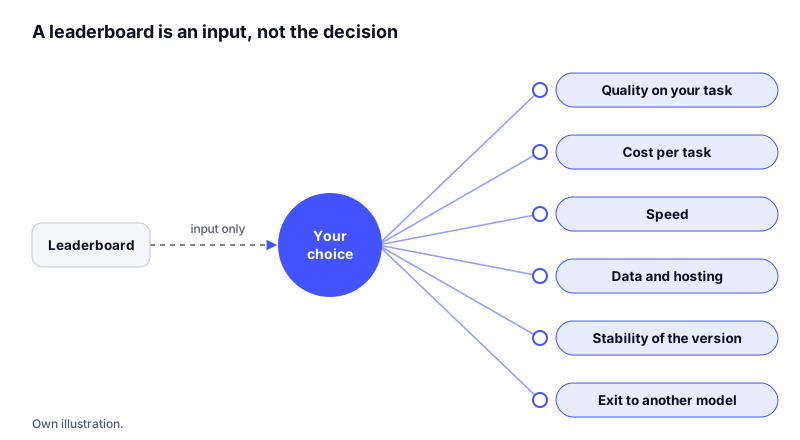
A comparison that helps a business weighs quality together with the conditions under which the model has to work:
| Criterion | Question | How to measure |
|---|---|---|
| Quality on your task | Does it get your real cases right? | Score answers on a test set of your own cases |
| Cost per task | What does one finished task cost? | Tokens per task × price, plus checks and retries |
| Speed | Is it fast enough where people wait? | Response time on the same test set |
| Data and hosting | Where is data processed, and may it be used for training? | Contract terms, region, data processing agreement |
| Stability | How long will this version be available? | Provider lifecycle and notice periods |
| Exit | Can we switch without rebuilding? | Test the same workflow with a second model |
How to compare models on your own tasks
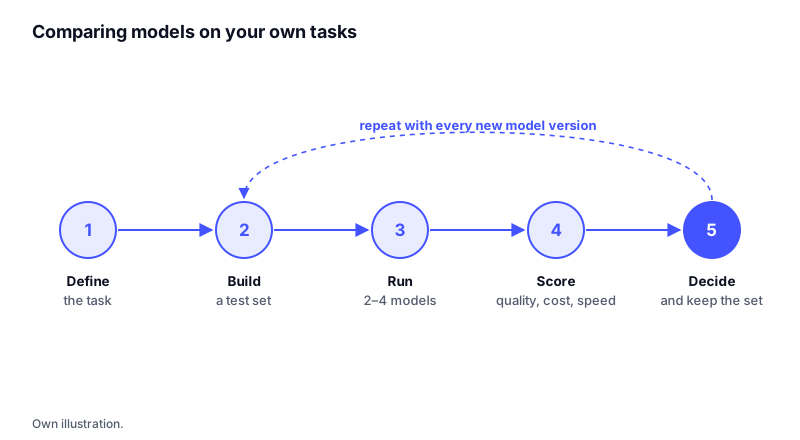
The method is simple and works for companies of any size. Define one task and what a good result looks like. Collect a few dozen real, anonymised cases, including difficult ones. Run two to four candidate models on exactly the same cases with the same instructions. Score the answers blind against your definition of good, and record cost and response time alongside. Then decide – and keep the test set, because it becomes your check every time a provider releases a new version.
The NIST AI Risk Management Framework describes the same principle in general terms: measure AI systems in the context in which they are used, and keep measuring over time.
Worked example: cost per 1,000 requests
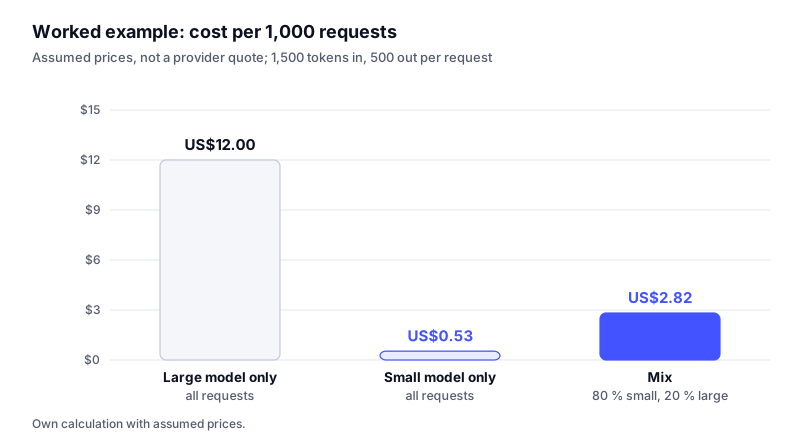
Worked example (our own calculation with assumed prices, not a quote from any provider): a task sends about 1,500 tokens to the model and receives about 500 back. A large model is assumed to cost US$3.00 per million input tokens and US$15.00 per million output tokens; a small model US$0.15 and US$0.60.
Large model only: 1,000 × (1,500 × 3.00 + 500 × 15.00) / 1,000,000 = US$12.00 per 1,000 requests. Small model only: about US$0.53. If tests show that the small model handles 80 % of the cases well and only 20 % need the large one, the mix costs about US$2.82 per 1,000 requests – less than a quarter of the large-model price, at the quality the test set confirmed.
The numbers change with every price list; the lesson does not. Compare cost per finished task, and let the test set decide which steps a smaller model can take over.
Data protection and the EU AI Act in the comparison
For companies in the EU, two legal questions belong in every comparison. Under the GDPR, a provider that processes personal data on your behalf needs a data processing agreement (Article 28), and transfers outside the EU need a legal basis under Chapter V. Under the EU AI Act, organisations that use AI systems must take measures for their staff’s AI literacy (Article 4, applicable since 2 February 2025), and providers of general-purpose AI models have had to supply documentation to the companies that build on their models since 2 August 2025. Asking a provider for that documentation is a fair part of the comparison. This is general information, not legal advice.
How NodeByNode helps
NodeByNode compares models vendor-neutrally on a company’s own tasks: we build the test set with the team, run the candidates, and report quality, cost, speed and data terms side by side. For critical answers we often recommend asking more than one model; for routine steps, a smaller one. Our AI consulting covers the choice, and managed AI repeats the check when models change.
Risks and limits
A test set only covers the cases in it; rare situations need human review. Prices, rankings and provider terms change, so any comparison has a date. Contract and data protection questions need legal advice for your specific case, and no comparison replaces the people who own the result.
AI model comparison: quick answers
Which AI model is best for business?
There is no single best model. At the top of public rankings models are now very close; the right choice depends on quality on your own tasks, cost per task, speed, data terms and how long a version stays available.
How do you compare AI models for a specific task?
Collect a few dozen real, anonymised cases, run two to four models with the same instructions, score the answers blind against your definition of a good result, and record cost and response time alongside.
Are LLM leaderboards reliable?
They are a useful starting point but measure general prompts and benchmark questions, which can leak into training data. They do not show how a model performs on your documents and tasks.
How do I choose AI tools for business without lock-in?
Test each workflow with at least two models, keep your instructions and test set independent of one provider, and check each provider’s lifecycle and notice periods for model versions.
What does the EU AI Act mean for choosing a model?
Companies using AI must ensure AI literacy among staff (Article 4), and providers of general-purpose AI models must supply documentation to those who build on them. You can ask for it during the comparison. Not legal advice.
Sources
- Stanford HAI (2025): AI Index Report 2025, Chapter 2 – Technical Performance
- Chiang et al. (2024): Chatbot Arena – An Open Platform for Evaluating LLMs by Human Preference, ICML 2024 (PMLR 235)
- Stanford CRFM (2022): Holistic Evaluation of Language Models (HELM)
- Xu, Guan, Greene, Kechadi (2024): Benchmark Data Contamination of Large Language Models – A Survey
- Anthropic: Model deprecations (example of a provider lifecycle policy)
- NIST: AI Risk Management Framework (AI RMF 1.0)
- Regulation (EU) 2016/679 (GDPR), Art. 28 and Chapter V
- Regulation (EU) 2024/1689 (AI Act), Art. 4 and Art. 53
- Skadden (14 August 2025): EU’s general-purpose AI obligations are now in force
Want to talk about how this applies to your company? [email protected]